
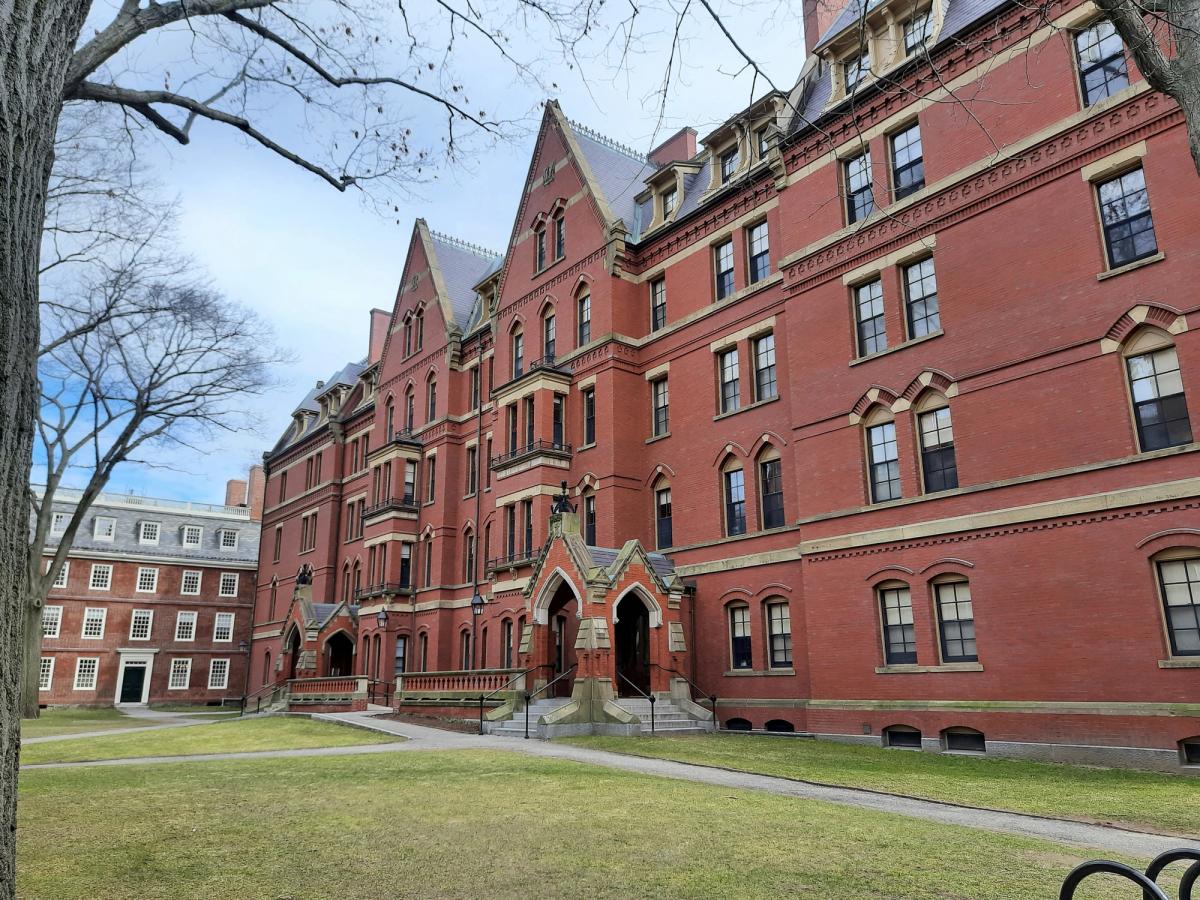
For many UK families, Harvard is the school that defines the most prestigious tier of American higher education. It represents academic excellence, global influence, and extraordinary selectivity, and is often viewed as the American equivalent of Oxford or Cambridge. Founded in 1636, Harvard is the oldest institution of higher education in the United States. Its alumni include US presidents, Nobel Prize winners, business leaders, and pioneering researchers, while its faculty and research have helped shape fields ranging from medicine and science to public policy and technology. Yet many families assume Harvard admissions operates much like Oxbridge admissions. As we explored in our guide to the US college admissions process, the two systems are built on fundamentally different philosophies. Harvard offers perhaps the clearest example of why that distinction matters.
Harvard's admissions process reflects the broader American approach of evaluating students as individuals rather than simply by their exam results. Academic achievement remains essential, but admissions decisions also take into account a student's extracurricular involvement, recommendations, personal essays, test scores, and potential contribution to the college community. At Harvard’s level of selectivity, success depends on how those different elements of the application come together.
Most applicants are already highly accomplished students. The real question is not whether a student meets Harvard's academic standards, but whether they have spent their secondary-school years developing the interests, pursuits, and achievements that distinguish them in one of the world's most competitive admissions processes.
Harvard at a Glance
Harvard College is the undergraduate college of Harvard University. Based in Cambridge, Massachusetts, it had a total undergraduate enrolment of around 6,675 undergraduates in Fall 2025. Its most recent admissions profile for the graduating Class of 2029 illustrates the scale of competition: Harvard received 47,893 applications, admitted 2,003 students, and enrolled 1,675, resulting in an admit rate of 4.2% and a yield rate of 83.6%.
| Key Facts | Latest Figures |
|---|---|
| Applications Received | 47,893 |
| Students Admitted | 2,003 |
| Students Enrolled | 1,675 |
| Admit Rate | 4.2% |
| Yield Rate | 83.6% (the percentage of admitted students who enrolled) |
| International students in entering class | 16% (by permanent address) |
Harvard Is Not an Oxbridge Application in American Clothing
One of the most common mistakes UK families make is assuming that Harvard assesses applicants in much the same way as Oxford or Cambridge. In reality, the two universities are asking very different questions.
While Oxford and Cambridge are primarily evaluating a student's suitability for a specific course, Harvard, by contrast, admits students to Harvard College before they choose a field of study. Students do not declare a concentration until their second year, so the admissions process is not centred on selecting students for individual degree programmes in the way it is at Oxford and Cambridge. Instead, Harvard is building a class of students who will contribute to the college and who show the academic ability, intellectual curiosity, character, and potential to excel within its liberal arts environment.
The question, then, is not "Is this student right for this course of study?" but "Is this student right for Harvard?” For UK applicants, that distinction matters because it shapes every part of the application, from academic choices and extracurricular activities to recommendations and essays.
What Harvard Actually Looks For
Harvard is clear about what it looks for in applicants. The College says it seeks students who will contribute to the Harvard community during their college years and to society throughout their lives. Academic excellence remains essential, but in a pool this selective, it is rarely sufficient on its own. Indeed, Harvard stresses that it does not admit "by the numbers." Rather, the admissions committee considers not only academic accomplishment but also the experiences, talents, perspectives, and potential contributions students would bring to campus.
This becomes particularly evident in Harvard's approach to extracurricular activities. The College is far more interested in the quality of a student's activities than in their quantity, and recognises that contributions to school, community, work, and family are all relevant. It explicitly notes that an applicant may demonstrate character and excellence through work, family responsibilities, community involvement, or other meaningful commitments, not only through more traditional extracurriculars.
Harvard's current application supplement reinforces the same theme. The required short-answer questions ask applicants to reflect on the experiences that have shaped them, how they would contribute to the community, and how they hope to make use of a Harvard education. Taken together, the prompts are less about cataloguing achievements than understanding the person behind them.
How the Application Works
Applications to Harvard College are submitted through the Common Application. Applicants complete the main application, the Activities section, and the personal essaybefore submitting Harvard's own supplement, the "Harvard Questions.” Both the Common App and the Harvard supplement must be submitted for the application to be considered complete.
Applicants' secondary schools must also submit several supporting documents as part of the application process:
- A Secondary School Report from a counselor or school leader, including transcripts, a letter of recommendation, and a school profile, if available
- A Midyear School Report
- Predicted grades for IB and A-Level students if official midyear grades are not issued
- Two teacher evaluations in different academic subjects
Testing is more nuanced than many families realise. Harvard currently requires applicants to submit SAT or ACT scores. In exceptional circumstances where those tests are not accessible, however, applicants may instead submit other academic qualifications, such as AP results, IB actual or predicted scores, GCSE or A-Level actual or predicted results, or results from other externally assessed national school-leaving examinations. TOEFL, IELTS, and Duolingo scores may also be submitted, but they do not satisfy Harvard's testing requirement.
Harvard does not set minimum score requirements or cutoffs. Nevertheless, the test scores of enrolled students are exceptionally strong: according to the most recent testing data published by Harvard, the middle 50 percent scored approximately 670–790 in SAT Evidence-Based Reading and Writing, 680–800 in SAT Math, and 31–36 on the ACT. Test scores are only one part of the application and are considered alongside a student's academic record, achievements, and potential.
Perhaps the most important thing to understand about Harvard interviews is that they are not guaranteed. Harvard assigns interviews at its discretion and based partly on alumni availability, so applicants cannot request one. As a result, some applicants will not be interviewed, but Harvard makes clear that not receiving an interview does not hurt an applicant's chances of admission.
Harvard's application timeline is straightforward:
- 1 August: Common Application opens
- Late October (recommended): SAT, ACT, or other qualifying test results available
- 1 November: Restrictive Early Action (REA) application deadline
- 1 January: Regular Decision (RD) application deadline
- Mid-February: Midyear reports requested
- Mid-December: REA decisions released
- End of March: RD decisions released
- 1 May: Deadline for admitted students to accept or decline their offer
For UK students, these deadlines fall during Year 13, but the application process typically begins in the summer between Years 12 and 13.
Restrictive Early Action and Why Timing Matters
Harvard’s Restrictive Early Action option limits where else applicants can apply early. Applicants may not apply early to another private US college, but they may apply early to public universities, military academies, and universities outside the United States, provided those applications are non-binding.
Harvard maintains that REA itself does not provide an admissions advantage. According to the university, higher early admit rates are explained by the strength of the students who apply early, not by the fact that they applied early.
The real question, then, is not whether REA improves an applicant’s chances, but whether the application will be stronger in November or January. Harvard notes that applying Regular Decision can offer practical advantages: more time to refine the application, more time for teachers and counselors to get to know the student, and more time for senior-year academics and extracurricular achievements to develop. For many UK applicants, this is the key consideration. If an application will not be fully developed by late October, applying REA may simply mean submitting a weaker application sooner.
Expert Guidance Makes a Difference
The admissions data leave little room for doubt about how competitive Harvard has become. With an admit rate of just over 4 percent and a yield consistently above 80 percent, even exceptionally qualified applicants do not receive an offer.
Harvard's own admissions guidance helps explain why so many outstanding applicants are unsuccessful. Most competitive applicants already have excellent grades and strong academic records, so academic achievement alone rarely distinguishes one candidate from another. Harvard recommends that students pursue the most demanding academic programme available to them throughout secondary school. Its guidance on extracurricular involvement emphasises depth and sustained commitment rather than simply accumulating activities, while its application supplement favours students who can clearly articulate their interests, motivations, and ambitions. The message is clear: a strong Harvard application is developed over time, not assembled in the weeks before the deadline.
For families, the takeaway is simple: at Harvard, academic excellence is expected, not exceptional. What distinguishes successful applicants begins long before Year 13. It is built over time through academic choices, sustained commitments, intellectual development, and careful reflection on what the student has to offer. The right support can help students make informed academic and extracurricular choices, identify meaningful opportunities, develop their strengths more deliberately, and present their story with the clarity and insight that this level of competition demands.