
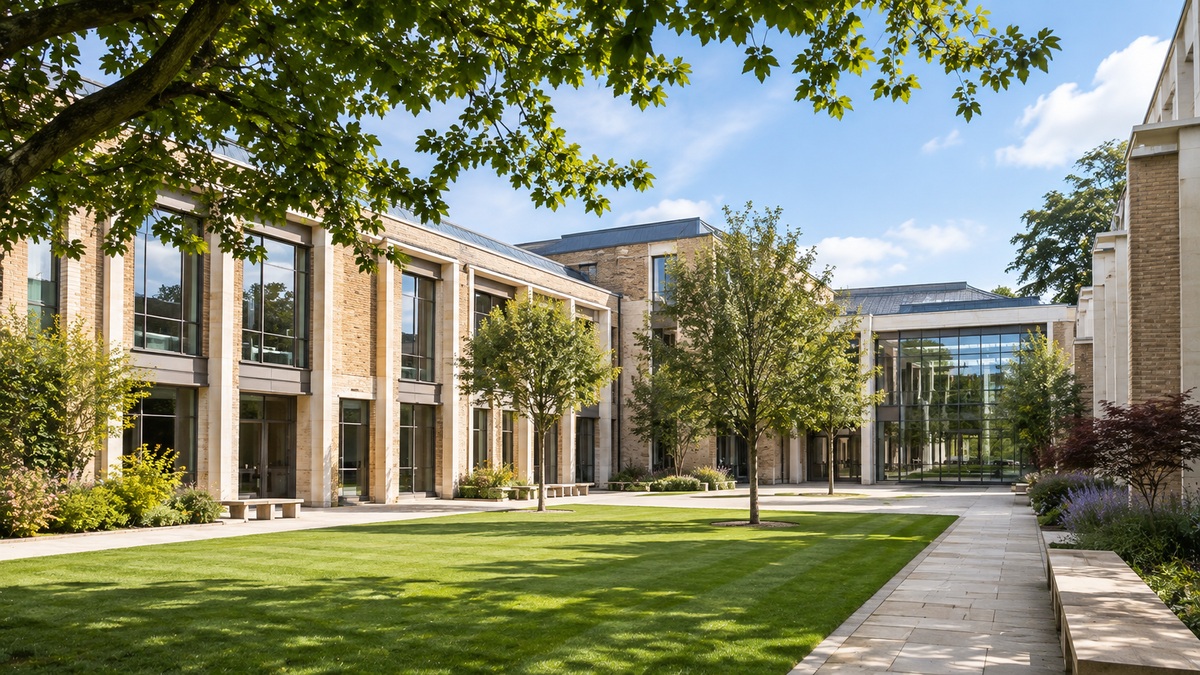
St Paul’s Prep School, formerly St Paul’s Juniors, admits approximately 72 boys into Year 3 each year at 7+, one of its two main entry points alongside 11+. For September 2028 entry, boys sit written tests in English, Mathematics and Reasoning in the autumn term of Year 2, and those who perform well return for a half-day group assessment before offers are made.
The process belongs to a school with more than five centuries behind it. St Paul’s School was founded in 1509 by John Colet, Dean of St Paul’s Cathedral, and in 1870 it was one of only two day schools included by the Clarendon Commission among the ‘nine great public schools’ of England. Its preparatory school — known in earlier generations as Colet Court — educates boys aged 7–13 on the same 45-acre site beside the Thames in Barnes, where the Prep School moved into its redeveloped home in January 2026, bearing a new name. Academic ambition is matched by a clear sense of purpose: the school states that its assessment process is designed to identify boys ‘who have a natural flair for learning and who will thrive on our education’.
The routes in have also narrowed. Under the school’s Admissions Policy (reviewed June 2026 and published on its School Policies page), the 8+ is no longer a standard entry point; occasional places may arise between the start of Year 4 and the start of Year 6, for which the school keeps a short waiting list and asks families to write to the Head. For most families, therefore, the 7+ is the door to the school, and this guide is written for boys joining Year 3 in September 2028.
How Many Boys Join St Paul’s Prep School at 7+?
St Paul’s Prep School admits approximately 72 boys at the 7+ entry point. They join the Lower First Year, which the school describes as a period of settling in and adjusting to life in a large, fast-moving prep school; for most of the timetable, boys are taught in their own form room, so that routine and stability come first.
The longer view matters as much as the first year. Pupils at St Paul’s Prep School hold a place at St Paul’s School and transfer at the end of Year 8, subject to good work, conduct and the academic standards of the senior school. Boys are accepted on the understanding that St Paul’s will be their first choice of senior school — a commitment families should weigh at the outset, not at 13.
When Does Registration Open for 2028 Entry?
Registration for 7+ entry in September 2028 opens in February 2027; the school has not yet published the closing date. For comparison, registration for 2027 entry ran from Wednesday 25 February to Friday 25 September 2026 and is now closed. Boys may be registered from the February of Year 1, and candidates must be seven by 31 August in the year of entry.
Registration is online and late registrations are not accepted. A boy is formally registered only once the online form, a valid passport and the non-refundable registration fee of £240 (including VAT) have been received, and everyone with legal responsibility for the child must consent to the application. Families are asked to tell their son’s current school that they have applied, and St Paul’s will seek a detailed report from the current Head on the boy’s character, academic ability, wider involvement and achievements.
What Is in the St Paul’s 7+ Exam?
All candidates sit written tests in English, Mathematics and Reasoning at St Paul’s Prep School in the autumn term of Year 2. According to the school’s Selection Procedure page, the English task is a dictation exercise, the Mathematics and Reasoning tasks follow a similar pattern to previous years and the Reasoning results are weighted according to age. The school does not publish past papers.
The dictation deserves particular attention. It looks simple on paper, yet it asks a boy of six or seven to hold a sentence in his head while his pencil catches up — a test of listening and concentration as much as of spelling and handwriting. The age-weighting of the Reasoning paper is also worth understanding: a boy born in late summer is not measured against one nearly a year older on equal terms, which is a fair safeguard in a cohort where months still matter.
The Group Assessment and the Meeting with the Head
Boys who perform well in the written tests are invited back for a half-day group assessment in groups of approximately 10. The morning comprises a Maths lesson, an English lesson and a group problem-solving task, so that the school sees each boy learning, listening and collaborating, not only answering questions on paper. At the same time, parents meet the Head of St Paul’s Prep School, Oliver Snowball, in small group sessions.
The group assessments take place in the two weeks after the written tests, so families know the outcome within a fortnight. Where places are limited, offers are made in rank order to boys who have shown across every stage that they can comfortably meet the school’s academic standards and have the potential to thrive. To accept, parents return the signed Acceptance Form and pay a deposit of £3,300 by the deadline in the offer letter; the deposit also covers the senior school and is returned only when the boy leaves St Paul’s.
What Are the Key Dates for 2028 Entry?
The only confirmed date for 2028 entry so far is that registration opens in February 2027. The remaining dates will appear on the school’s Important Dates page; until then, the 2027 cycle below is the best guide to the pattern, not a promise of the 2028 timetable.
| Stage (2027 entry, for reference) | Date |
|---|---|
| Registration opened | Wednesday 25 February 2026 |
| Registration closed | Friday 25 September 2026 |
| Open morning | Saturday 7 November 2026 |
| 7+ exam | Saturday 21 November 2026 |
| Classroom visits for selected candidates | Tuesday 24 November – Thursday 3 December 2026 |
| Final outcome sent to parents | Friday 4 December 2026 |
| Acceptance deadline | Noon, Thursday 28 January 2027 |
What Does St Paul’s Prep School Cost?
For 2026/27, fees at St Paul’s Prep School are £10,221 per term, including VAT, for Years 3–8. Fees for 2028/29 have not yet been published. On top of the termly fee, the registration fee is £240 (including VAT, non-refundable) and the acceptance deposit is £3,300.
Preparing a Boy for the 7+
Good preparation for the 7+ starts with the habits the tests reward: reading widely and aloud, listening carefully, explaining a method in words and tackling an unfamiliar problem without losing heart. Because the English paper is a dictation and there are no past papers, steady work on spelling, handwriting and concentration tends to serve a boy better than any attempt to second-guess the questions; the group assessment, meanwhile, rewards a child who is used to thinking aloud and working alongside others.
Timing matters too. A boy sitting the 7+ in the autumn of 2027 will do so early in Year 2, so most of the groundwork falls in Year 1 and the summer that follows. Our guide to 7+ and 8+ exam preparation sets out what each kind of paper tests and a timeline for 2028 entry, and our 7+ admissions tutors for St Paul’s and other London prep schools work with families through each stage. Many families sit several 7+ assessments in the same autumn; our guides to Westminster Under School and City Junior School set out their processes.
The Think Tutors Perspective
St Paul’s Prep School is clear about what it seeks: boys who are curious, quick to learn and ready to thrive in a large and lively school. With 8+ no longer a standard entry point, the 7+ carries more weight than it once did, and the families who fare best are those who plan early and understand each stage before it arrives.
Think Tutors provides highly personalised advice on school selection, admissions strategy, entrance examinations and interviews. Ninety-six percent of our students are offered a place at one of their top-choice institutions.
At seven, the best preparation does more than ready a boy for a single autumn morning. It builds the skills and confidence — careful listening, clear explanation, a willingness to try — that he carries with him into every classroom that follows.