
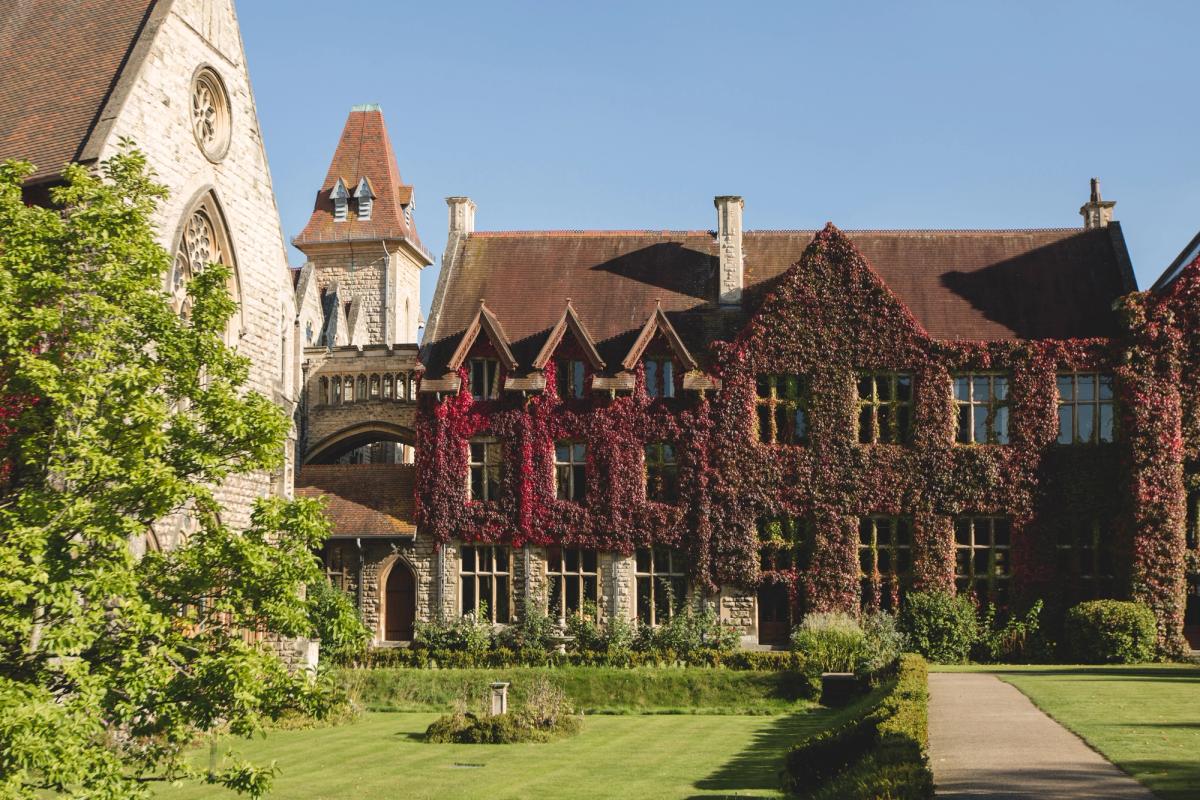
At Think Tutors, our relationships with leading schools extend beyond understanding entrance examinations and admissions criteria. In order to advise families fully, we believe it is necessary to know the schools: to visit them, develop relationships with those working within them, and understand those qualities that can never quite be captured by a prospectus.
Recently, I spent a day at Cheltenham Ladies’ College (CLC), one of Britain’s leading names in girls’ education. Founded in 1853, CLC has been educating young women for more than 170 years; today, its community comprises around 820 pupils, the substantial majority of whom board. I was told during my visit that demand remains considerable, with approximately three applicants for every available place.
My first tour took me through the main College buildings. My second was ostensibly a tour of the boarding houses but, inevitably, became a tour of Cheltenham itself.
CLC’s teaching buildings, boarding houses, performance spaces, and sporting facilities are distributed across a 36-acre estate through the heart of the Regency town. There is something quasi-collegiate about it, with ‘town’ and ‘gown’ interspersed in a manner reminiscent of Cambridge, Durham, or Oxford.
Academic Ambition
Such expansiveness is matched by considerable academic ambition.
CLC’s 2026 examination results were very strong. At A Level, 69% of entries received A* or A grades, with 91% graded A*–B. At GCSE and IGCSE, 71% of results were awarded grades 9/8/A*, while 87% achieved 9–7/A*–A.
CLC also offers the International Baccalaureate Diploma. Its 2026 IB cohort achieved an average score of 40.6 points, with more than 70% attaining 40 points or above. Leavers progressed to institutions including Cambridge, Durham, Imperial, Oxford, UCL, and St Andrews, as well as Brown, Cornell, UCLA, and other leading universities internationally.
A Community of Musicians
The musical provision at CLC is exceptional, with approximately 50 specialist music teachers delivering more than 1,200 individual lessons and groups every week.
That statistic accords with what I encountered during my visit: one-to-one musical tuition does not feel peripheral to school life; for a significant proportion of pupils, it is embedded within the rhythm of the week.
The Music Department itself extends across four floors and contains dozens of teaching and practice rooms, while pianos are distributed liberally across the boarding houses. For a musically curious pupil — whether aspiring to conservatoire level or simply wishing to explore several instruments seriously — the breadth of opportunity is striking.
From Textiles to the Parabola
The work I saw at Cheltenham was possibly the finest I have encountered in a school Textiles Department. One dress in particular, constructed with a shredded-newspaper aesthetic, would have looked at home in the windows of Alexander McQueen.
This was not simply the enthusiasm of a style-conscious guest. This year, a CLC pupil was crowned national winner in her age category in the Young Fashion Designer UK Competition, while pupils have also worked with the JCA London Fashion Academy, founded by Professor Jimmy Choo, through workshops exploring fashion design, construction, and branding.
The Parabola Arts Centre is a professional-standard theatre with more than 300 seats alongside rehearsal spaces, a dance studio, dressing rooms, and gallery space. It is used for College drama and dance but also by visiting performers, speakers, and theatre companies.
The Town as Classroom
Cheltenham is often described as ‘The Festival Town’.
Each year it hosts four major Cheltenham Festivals devoted respectively to Jazz, Science, Music, and Literature, bringing leading musicians, writers, scientists, academics, and public figures to the town.
For pupils at CLC, this represents an extraordinary cultural resource on their doorstep. The College works with the Festivals, and the Parabola Arts Centre serves as one of their venues. The surrounding town naturally supplements the curriculum: pupils might encounter a discipline first in the classroom, or through distinguished practitioners actively shaping it just streets away.
A Tradition of Leading Women
Under the nineteenth-century leadership of Dorothea Beale, subjects including science, mechanics, and hydrostatics were introduced despite contemporary objections that such study was unsuitable for young women. Beale later played an important role in the foundation of St Hilda’s College, Oxford.
More than a century and a half later, the list of women educated at Cheltenham is remarkable. It includes Bridget Riley, one of the most important British artists of the post-war period; Cicely Mayhew, the first female British diplomat; former Home Secretary Amber Rudd; Dame Cheryl Gillan, the first woman to serve as Secretary of State for Wales; and Dame Clare Marx, the pioneering orthopaedic surgeon who became the first female President of the Royal College of Surgeons of England and later the first woman to chair the General Medical Council.
The Think Tutors Perspective
CLC is a large and highly ambitious school. For families considering CLC, or deciding between leading day and boarding schools more broadly, Think Tutors provides highly personalised advice on school selection, admissions strategy, entrance examinations, and interviews. Our close relationships with schools, combined with first-hand knowledge of the environments in which our pupils may eventually study, allow us to advise where they will flourish.